Rick Williams: The Cop Who Taught Me the Ankle Lock
A Machado black belt from the Dirty Dozen, an LAPD hand-to-hand combat instructor, and part of
Written by Brian Scott
•5 min read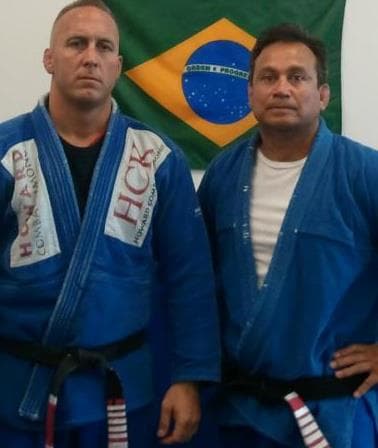
July 11, 2026
There are pioneers whose names you see on every list, and there are pioneers who spent their lives being the most dangerous man in a room without ever needing you to know it. Rick Williams is the second kind. He is one of the Dirty Dozen — the first twelve non-Brazilians to earn a black belt in Brazilian Jiu-Jitsu — and he earned his under Rigan Machado. But if you only know him from the history books, you are missing most of the story. I know him from the mat. He taught me a submission I've been winning with, and teaching, for years.
The Wrestler Who Found Jiu-Jitsu
Like a lot of the early American black belts, Rick came to Jiu-Jitsu through wrestling — a hard, grinding base that made him a nightmare on top before he ever learned a single Brazilian technique. He put in his years under the Machado brothers, and in 1996 that work paid off twice over: he won the Pan American Championship as a brown belt, and later that year Rigan Machado tied a black belt around his waist.
He wasn't promoted alone. Rick received his black belt in the same December 1996 group as Chris Haueter and Dave Meyer — three American pioneers, one ceremony, one lineage. On the commonly cited roster of the Dirty Dozen, Rick sits at number nine. Cross-training a wrestler's pressure with Machado Jiu-Jitsu, he was exactly the kind of grappler the era needed to prove that Americans belonged.
The Badge
Here is what separates Rick from most of the men on any Jiu-Jitsu list: for him, this was never a hobby or a competition hobbyhorse. It was survival gear.
Rick spent his career in law enforcement — a run that public accounts put at roughly 28 years — and for more than three decades he served as a hand-to-hand combat instructor for the Los Angeles Police Department. Think about what that means. The techniques the rest of us drill for medals, Rick was teaching to officers who would use them, that week, on the worst night of somebody's life. He has said plainly that Jiu-Jitsu saved his life more than once on the job. When Rick talks about the difference between sport grappling and the real thing, he isn't theorizing. He's remembering.
Kobe Duty
The story I always come back to is Kobe.
Rick's reputation for keeping people safe reached past the department and into executive protection, and one of the men he was assigned to protect was Kobe Bryant. Picture it: one of the original American BJJ black belts, an LAPD combat instructor, standing watch over the greatest Laker of his generation — including during games, keeping eyes on Kobe from the security detail while the Forum, and later Staples Center, roared. Public accounts of Rick's life confirm the executive-protection work with NBA superstars, Kobe included. The guy who could tie up a two-time Pan Am bracket was the guy they trusted to stand between a global icon and the crowd.
South Bay, and a Room Full of Legends
For years, the place to find Rick on the mat was South Bay Jiu Jitsu in Hermosa Beach — Bob Bass's academy. Bob is the owner and head instructor there, the first American black belt under Rigan Machado and a competition legend in his own right, and Rick taught and trained right alongside him. There's even a Bass-and-Williams instructional series out in the world, the two of them breaking down advanced Jiu-Jitsu together — which tells you everything about the respect between them.
Rick's teaching reached well beyond one gym, too. Over the years he instructed at UCLA and at Steven Seagal's Tenshin Dojo, and he helped build a grappling curriculum with fellow Dirty Dozen member John Will that got used around the world, including material tailored for Chuck Norris's UFAF association. Quiet man, enormous footprint.
The Ankle Lock
This is the part that's personal for me.
Rick is where I learned the straight ankle lock — and not the sanitized, modern, keep-your-knee-line-safe version. Rick taught it the old-school way, with the reap: the leg entanglement and the turn that make the finish inevitable when it's done right. It's a submission that carries a reputation for being "basic," and in Rick's hands it was anything but. It was a scalpel.
I took that ankle lock into my own competition career and had a tremendous amount of success with it. And I did what you're supposed to do with something a master hands you — I passed it on. My students at Tuff Buffs and Baseline Martial Arts have used the straight ankle lock, exactly as Rick taught it to me, to win tournaments many times over. Every one of those finishes traces back through me to a quiet LAPD cop who learned his Jiu-Jitsu in the Machado years. That's lineage you can feel with your hands.
Cameron
I can't write about Rick without writing about his son, Cameron.
Cameron Williams was a serious athlete — a highly competitive wrestler and BJJ player who did not care one bit about anybody's résumé. Back when I was fighting MMA and competing at a high level in tournaments, Cameron was around fifteen years old and already good enough to give me absolute fits on the mat. A teenager, testing a grown professional, and making him work for every inch. That's what growing up in Rick's house produced. The apple didn't fall far from the tree, and the tree was a Dirty Dozen black belt.
Why He Belongs to This Story
Black Belt Legacy exists to preserve the Machado lineage — not just the names and the promotion dates, but the actual transmission of the art from hand to hand. Rick Williams is that transmission at its purest. He took a wrestler's grit, folded in Rigan Machado's Jiu-Jitsu, carried it through a career where the techniques had to work, and then handed pieces of it to the next people down the line. One of those pieces landed with me, and through me with a room full of students who've never met him and win with his Jiu-Jitsu anyway.
That's the whole idea. That's the lineage doing exactly what it's supposed to do. This is a first pass at Rick's story — there is far more to tell, and we intend to tell it — but even the outline makes the point. Some of the most important pioneers are the ones who never needed the spotlight. Rick Williams is one of them.
Sources
Web-sourced facts (Rick's Dirty Dozen standing, competition record, law-enforcement career, executive protection for Kobe Bryant, and teaching history):
- Who Are The BJJ Dirty Dozen? — Jits Magazine: https://jitsmagazine.com/who-are-the-bjj-dirty-dozen/
- BJJ Dirty Dozen: The American Pioneers of Jiu Jitsu — Jiu Jitsu Legacy: https://jiujitsulegacy.com/bjj-lifestyle/bjj-dirty-dozen/
- BJJ Dirty Dozen — BJJ Heroes: https://www.bjjheroes.com/bjj-culture/bjj-dirty-dozen
- "Rick Williams, SWAT Cop & BJJ Pioneer: Jiu-Jitsu Saved My Life Dozens of Times" — The Ageless Warrior Lab (podcast, Ep. 17): https://www.buzzsprout.com/2501023/episodes/18340205-bjj-bonus-rick-williams-on-the-nba-his-life-in-law-enforcement-a-powerful-conversation-ep-17
- Bob Bass and Rick Williams Advanced BJJ (instructional) — Straight Blast Gym / Gumroad: https://straightblastgym.gumroad.com/l/HoHZ
- South Bay Jiu Jitsu (Hermosa Beach) — Tapology gym page: https://www.tapology.com/gyms/887-south-bay-jiu-jitsu
Firsthand / operator-provided facts (Brian Scott's direct knowledge — no web source): Rick's specific role as an LAPD hand-to-hand combat instructor for 30+ years; his assignment watching Kobe Bryant during Lakers games; teaching alongside Bob Bass at South Bay; the straight ankle lock with old-school reaping that Brian learned from Rick and carried into competition and into his Tuff Buffs / Baseline Martial Arts coaching; and Rick's son Cameron as a highly competitive teenage wrestler/BJJ player.